


Laos Wildlife: Immersion into the heart of a wild and preserved nature

Laos is one of the last natural sanctuaries in Southeast Asia where wildlife still evolves within a largely untouched environment. Here, jungles cover the mountains, rivers shape the landscapes, and animal life still follows the ancient rhythm of nature.
Traveling in Laos is not only about discovering landscapes… it is about entering a living ecosystem where every sound, every movement, and every encounter tells a story.
A biodiversity still largely untouched

What makes Laos so unique is this rare feeling of exploration. Unlike many other Southeast Asian countries, the territory remains lightly urbanized, leaving vast forest areas where nature can still express itself freely.
Within these sometimes hard-to-reach landscapes live species that remain little known, and in some cases not even fully studied. The dense vegetation, rich soils, and variety of climates create an ideal environment for an incredibly diverse wildlife, ranging from large mammals to the most discreet species.
The asian elephant: meeting a peaceful giant

It is impossible to talk about Laos wildlife without mentioning the elephant, one of the country’s living symbols. Once omnipresent, elephants accompanied local communities in everyday life, especially for transporting wood in mountainous regions.
Today, encountering an elephant in Laos remains a deeply emotional experience. What immediately stands out is not only its impressive size, but also its behavior. The Asian elephant radiates a sense of calmness, almost wisdom. Its movements are slow and precise, and its gaze seems filled with emotion.
In ethical sanctuaries such as MandaLao Elephant Conservation, the experience becomes even more meaningful. Visitors do not ride the animals. Instead, they walk alongside them, observe them interacting with their environment, and learn about their habits. It becomes an almost intimate encounter, far removed from exploitation. In the forests surrounding Luang Prabang, it is not uncommon to feel this unique connection with an animal that is both powerful and deeply sensitive.
The bears of Laos: between fragility and protection

More discreet than elephants, Laos’ bears represent another side of the country’s wildlife: fragile and threatened species that are still present.
The Asian black bear, recognizable by the white crescent on its chest, and the sun bear, smaller and more nervous, mainly live within tropical forests. Their daily lives unfold away from human eyes, between searching for food, climbing trees, and resting for long periods.
Unfortunately, these animals have been heavily impacted by poaching and illegal wildlife trade. That is what makes a visit to the Kuang Si Bear Rescue Centre particularly moving. Here, rescued bears recover within a protected environment close to their natural habitat.
Observing these animals in such conditions helps visitors better understand both their behavior and the importance of wildlife conservation. Located only a short distance from the famous Kuang Si Waterfalls, this experience combines emotion, awareness, and wonder.
Monkeys and Gibbons: the invisible voices of the jungle

In the Lao jungle, animals do not always reveal themselves… but they make themselves heard. At dawn, when mist still covers the mountains, the songs of gibbons echo through the forest. Powerful and almost unreal, these sounds immediately set the tone for the day. You quickly realize that you have entered a truly wild world where humans are only guests.
Gibbons, difficult to spot, live high in the trees and move through the canopy with incredible agility. Their discreet and aerial lifestyle contrasts with macaques, which are more visible and sometimes curious. In protected areas such as Nam Kan National Park or Nam Et-Phou Louey National Park, these encounters become even more immersive. It is not simply about observing an animal… but about experiencing the jungle through its sounds and sensations.
The Big Cats: invisible presence, tangible tension
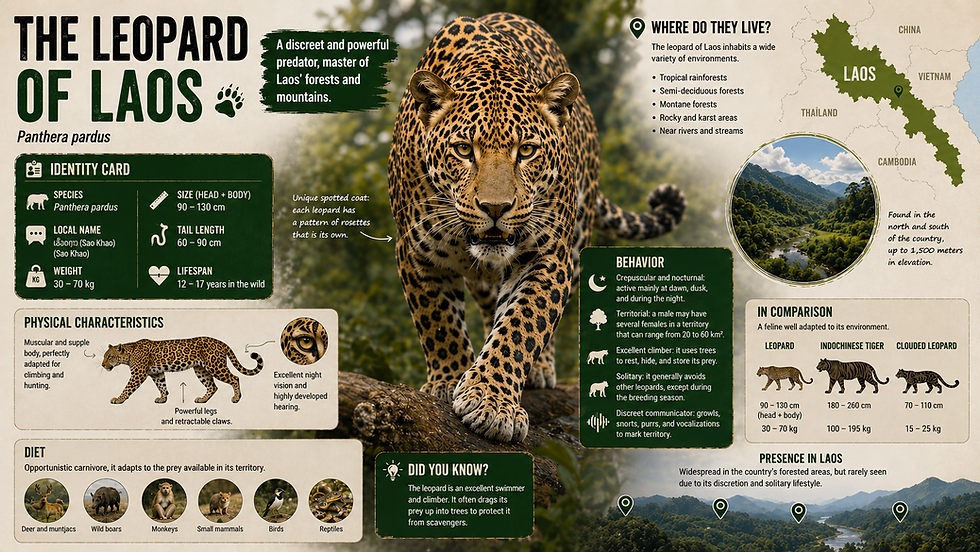
The wild cats of Laos belong to those presences you almost never see… but definitely feel. The Indochinese tiger, the leopard, and the Asian golden cat inhabit remote areas, mostly at night. Their discretion is so remarkable that even the most experienced guides cannot guarantee an encounter. And yet, their presence changes everything.
It gives the forest a mysterious, almost mystical dimension. During a night safari in Nam Et-Phou Louey National Park, every sound and every movement in the darkness suddenly takes on a new intensity. It is a rare experience, far removed from classic safaris, where the goal is not necessarily to see wildlife… but to truly feel wild nature in its purest form.
Buffaloes, deer and rural life: harmony between humans and nature

In Laos, wildlife is not limited to remote areas. It is also part of everyday life. In the rice fields, buffaloes move slowly, often alongside their owners. Their presence is inseparable from the rural landscape. They symbolize a simple and respectful balance between humans and nature. More discreetly, deer live near forest edges, while the gaur, an impressive wild bovine, remains rarely seen but still present in certain regions. Around Vang Vieng or in the northern valleys near Nong Khiaw, these scenes of daily life give the journey a deeply authentic dimension. Here, nature is not separated from people, it is fully part of everyday life.
Birds: a permanent symphony
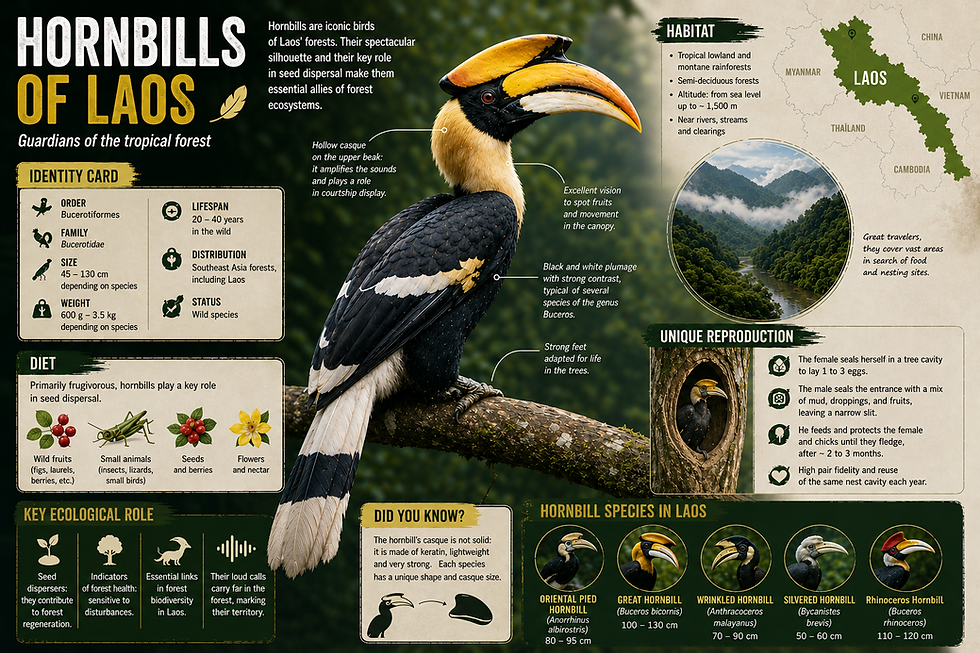
Laos is a true paradise for bird lovers. But even without being passionate about birdwatching, it is impossible not to notice their presence. From the first hours of the day, the forest comes alive. Calls, songs, and movements within the foliage create a vibrant and living atmosphere. Hornbills, with their impressive beaks, sometimes make spectacular appearances, while kingfishers brighten rivers with their vivid colors. In places such as Phou Khao Khouay National Park, birdwatching becomes almost meditative. You stop, listen, observe… and little by little, nature reveals itself.
Reptiles and aquatic life: discreet yet essential

Less visible but equally essential, reptiles and aquatic species play a crucial role in maintaining ecosystem balance. Geckos, for example, are almost part of daily life in Laos. They can often be seen silently resting on walls, perfectly adapted to their environment. Snakes remain discreet and mostly invisible, yet actively participate in regulating wildlife populations. In the Mekong River, aquatic life is equally rich. And in southern Laos, near Si Phan Don, it is sometimes possible to spot the rare Irrawaddy dolphin. A very rare, almost unreal encounter that reminds travelers just how unique Laos remains.
ORLA Tours: Experiencing Laos Wildlife Differently
At ORLA Tours, we create journeys that go far beyond simple sightseeing.
We take you where nature fully expresses itself through:
immersive experiences
authentic encounters
and a respectful approach to wildlife
👉 Would you like to discover Laos wildlife in the best possible conditions?
Fill out our discovery form to create a tailor-made itinerary designed especially for you.
FAQ – Laos Wildlife
Can you easily see animals in Laos?
Yes. Some animals such as buffaloes, monkeys, or birds are easy to spot, while others require more patience.
Is Laos a good destination for nature lovers?
Absolutely. It is even considered one of the best nature destinations in Asia.
Are animals protected in Laos?
Increasingly so, especially within national parks and wildlife sanctuaries.
Can you go on safari in Laos?
Yes, especially night safaris in certain protected reserves.
What is the best season for wildlife observation?
The dry season, from November to March, is ideal. However, wildlife can be observed in Laos throughout the entire year.
Comments